
Contracting Cone
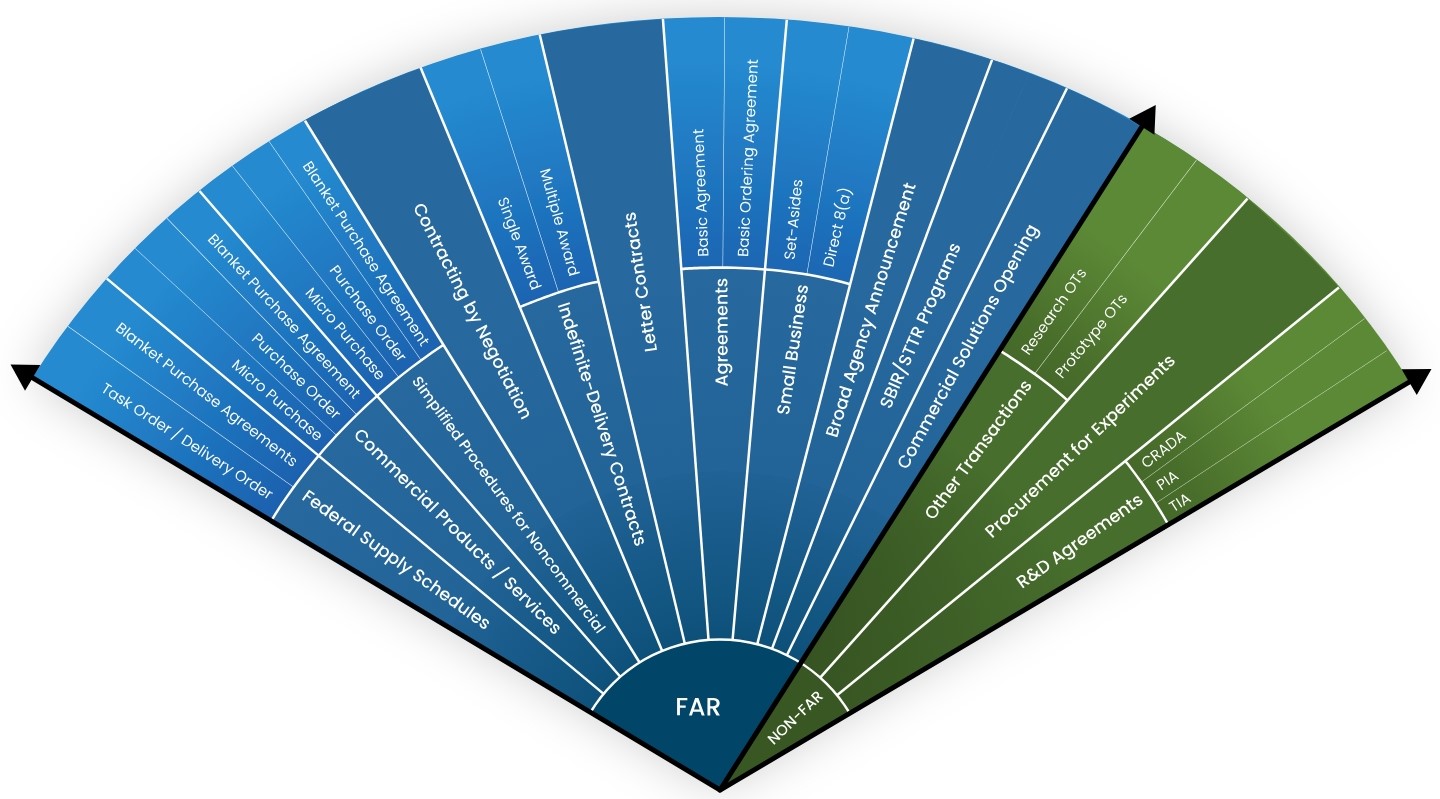
FAR Based Strategies
Ordering under the Federal Supply Schedule
Acquisition of Commercial Products and Commercial Services
Simplified Procedures for Noncommercial Acquisitions
Contracting by Negotiation
Indefinite-Delivery Contracts
Letter Contracts
Agreements
Small Business
Broad Agency Announcement
Commercial Solutions Opening
Statutory Strategies
SBIR/STTR Programs
Other Transactions
Procurement for Experiments
R&D Agreements
Cooperative R&D Agreement
Partnership Intermediary Agreement
Technology Investment Agreement
Contract Type Matrix
Basic Agreement
FAR 16.702
A basic agreement is a written instrument of understanding negotiated between the Government and a contractor. It is not a contract. A basic agreement contains contract clauses that will apply to future contracts between the parties during the term of the agreement and contemplates separate future contracts that incorporate the agreed-upon clauses by reference or attachment.
A basic agreement should be used when the Government expects to award a substantial number of separate contracts to a contractor during a particular period and significant recurring negotiating problems have been experienced with that contractor. Basic agreements may be used with negotiated fixed-price or cost-reimbursement contracts.
Common Applications
- Supplies or services
- Substantial number of separate contracts anticipated
- Significant recurring negotiating problems experienced with the contractor
- Situations where pre-negotiated clauses can streamline future contract negotiations
Pros |
Cons |
| Pre-negotiated clauses can reduce recurring negotiation burden. | A basic agreement is not a contract and does not authorize work or obligate funds. |
| Can support future negotiated fixed-price or cost-reimbursement contracts. | It may be changed only by modifying the agreement itself, not by a contract incorporating the agreement. |
| May be modified or discontinued without affecting prior contracts that incorporated the agreement. | It must be reviewed annually and revised as needed to conform to current FAR requirements. |
| Contracting officers should use existing basic agreements of another agency to the maximum practical extent. | Future contracts must still include the specific scope of work, price, delivery, and other applicable terms. |
Restrictions
- Must not cite appropriations or obligate funds.
- Must not state or imply that the Government will place future contracts or orders with the contractor.
- Must not be used to restrict competition.
- Each basic agreement must provide for discontinuing future applicability upon 30 days’ written notice by either party.
- Each basic agreement must be reviewed annually before the anniversary of its effective date and revised as necessary.
- Contracts incorporating a basic agreement must include a scope of work, price, delivery, and other appropriate terms.
- The basic agreement must be incorporated into the contract by specific reference, including reference to each amendment, or by attachment.
- When new work is added to an existing contract, the modification must incorporate the most recent basic agreement unless the contract or modification already includes all required clauses as of the date of the modification.
Resources
- FAR Subpart 16.7 Agreements
- FAR 16.702 Basic Agreements
- Contract Formation: Basic Agreements and Basic Ordering Agreements, Federal Acquisition Insitutue
0 Comments