
Contracting Cone
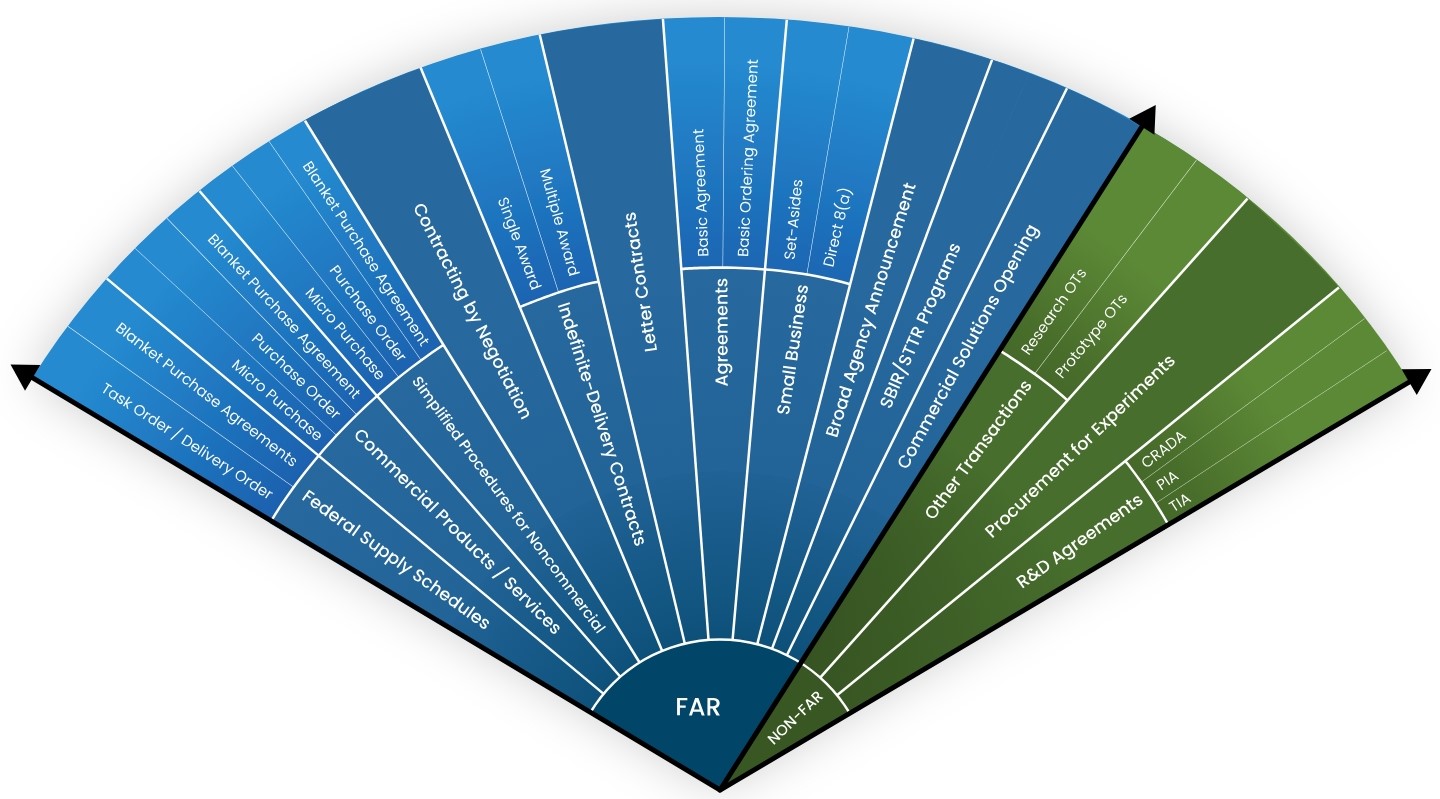
FAR Based Strategies
Ordering under the Federal Supply Schedule
Acquisition of Commercial Products and Commercial Services
Simplified Procedures for Noncommercial Acquisitions
Contracting by Negotiation
Indefinite-Delivery Contracts
Letter Contracts
Agreements
Small Business
Broad Agency Announcement
Commercial Solutions Opening
Statutory Strategies
SBIR/STTR Programs
Other Transactions
Procurement for Experiments
R&D Agreements
Cooperative R&D Agreement
Partnership Intermediary Agreement
Technology Investment Agreement
Contract Type Matrix
Technology Investment Agreement
32 C.F.R. Part 37
A Technology Investment Agreement, or TIA, is a special class of DoD assistance instrument used to stimulate or support research. TIAs are intended to increase commercial firm participation in defense research programs, promote civil-military integration, and reduce barriers that might otherwise discourage commercial firms from participating in DoD research. 32 C.F.R. Part 37 establishes uniform DoD policies and procedures for the award and administration of TIAs.
A TIA may be structured as a kind of cooperative agreement or as a type of assistance transaction other than a grant or cooperative agreement. TIAs are not procurement contracts and should not be used when the principal purpose is to acquire goods or services for the direct benefit or use of the Government.
TIAs are most appropriate when the research effort involves commercial firms and use of a TIA is expected to benefit the Government by reducing barriers to commercial participation, supporting dual-use technology development, or allowing more flexible treatment of intellectual property, cost sharing, payment arrangements, or other agreement terms.
Common Applications
- Defense research involving commercial firms
- Dual-use technology research
- Civil-military integration efforts
- Research efforts where standard grants, cooperative agreements, or procurement contracts may discourage commercial participation
- Research requiring tailored intellectual property, data rights, payment, or cost-sharing arrangements
Pros |
Cons |
| Helps attract commercial firms to DoD research programs. | Requires experienced agreements, legal, technical, and financial personnel. |
| Allows more flexible agreement terms than traditional procurement contracts. | Not appropriate when the Government’s principal purpose is acquiring goods or services for direct Government use. |
| Can support civil-military integration and dual-use technology development. | Cost-sharing, payment structure, intellectual property, and audit provisions require careful negotiation. |
| May be structured as an expenditure-based or fixed-support TIA. | Less familiar than standard contracts, grants, or cooperative agreements. |
| Can reduce barriers associated with traditional Government research instruments. | The award must still comply with applicable DoD assistance regulations and Component procedures. |
Restrictions
- Must be used to stimulate or support research.
- Should be used only when a TIA is the appropriate instrument for the project and recipient.
- TIAs may be expenditure-based or fixed-support, subject to the conditions in 32 C.F.R. Part 37.
- Cost sharing is generally expected to the maximum extent practicable.
- A TIA may not provide fee or profit to participants.
- TIAs must be awarded or administered by officials authorized under DoD Component procedures.
- TIAs are not FAR-based procurement contracts and should not be used to bypass procurement requirements.
0 Comments