
Contracting Cone
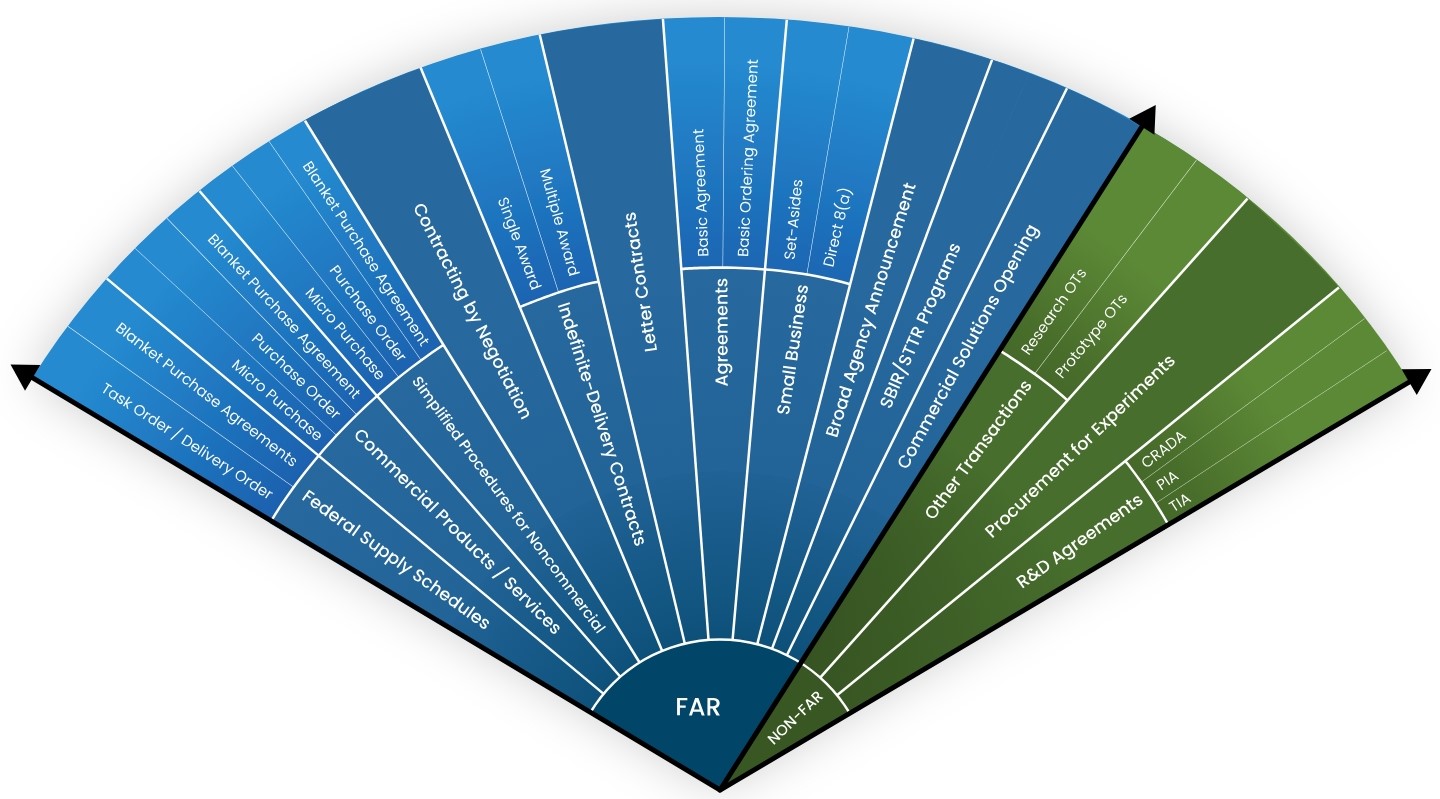
FAR Based Strategies
Ordering under the Federal Supply Schedule
Acquisition of Commercial Products and Commercial Services
Simplified Procedures for Noncommercial Acquisitions
Contracting by Negotiation
Indefinite-Delivery Contracts
Letter Contracts
Agreements
Small Business
Broad Agency Announcement
Commercial Solutions Opening
Statutory Strategies
SBIR/STTR Programs
Other Transactions
Procurement for Experiments
R&D Agreements
Cooperative R&D Agreement
Partnership Intermediary Agreement
Technology Investment Agreement
Contract Type Matrix
Contracting by Negotiation
FAR Part 15
FAR Part 15 addresses policies and procedures used in competitive and noncompetitive negotiated acquisitions. These procedures provide an opportunity for back-and-forth negotiation between the Government and one or more offerors after proposals are submitted in response to a request for proposals. FAR Part 15 may be used when another acquisition method, existing contract vehicle, or required source does not meet the agency’s needs, or when the nature of the requirement calls for proposal-based evaluation, negotiation, and award.
Under RFO FAR Part 15, negotiated acquisitions may be either competitive or noncompetitive. Competitive acquisitions are used when award is made after soliciting offers from multiple sources. Noncompetitive acquisitions are used when award is made to a single vendor without soliciting offers from multiple sources, subject to the applicable justification and approval requirements.
RFO FAR Part 15 emphasizes tailoring the acquisition approach to the circumstances of the requirement. Agencies should tailor the complexity of the request for proposals, evaluation, and source selection decision while maintaining an impartial and comprehensive evaluation process that results in the proposal representing the best value to the Government. RFO FAR Part 15 also encourages early exchanges with industry, including draft RFPs, conferences, and requests for information, when appropriate.
Common Applications
- Complex supplies and services, including construction when negotiated procedures are appropriate
- Defense business systems and enterprise resource planning systems
- Mission-focused solutions and technologies
- IT software, products, systems, and agile development efforts
- Weapon systems, aircraft, ships, and space systems
- Research and development
- Advisory and assistance services
- Engineering services
- Special studies
- Requirements requiring tradeoffs, discussions, negotiations, or tailored evaluation approaches
Pros |
Cons |
| Allows the Government to tailor the solicitation, evaluation approach, terms and conditions, and pricing arrangement to the requirement. | May require more acquisition planning, evaluation support, and documentation than more streamlined procedures. |
| Supports best-value source selection, including tradeoff and lowest price technically acceptable approaches when appropriate. | Selection of appropriate terms and conditions, including data rights increases burden on Government to ensure terms are explicit |
| Allows exchanges with industry before proposal submission, which can improve the Government’s understanding of market capabilities and industry’s understanding of the requirement. | Selecting appropriate terms, conditions, data rights, and evaluation factors can increase the burden on the acquisition team. |
| Allows discussions and proposal revisions when needed to improve the Government’s ability to obtain best value. | Discussions, competitive range decisions, debriefings, and protest risk require disciplined execution. |
| Provides flexibility for large, complex, or mission-critical requirements with no fixed upper dollar threshold. | Requires the Government to ensure the final award decision follows the solicitation’s stated evaluation criteria. |
Restrictions
- FAR Part 15 should be used when the requirement is not better satisfied through required sources, existing contracts, Federal Supply Schedule ordering, commercial procedures, simplified acquisition procedures, sealed bidding, or another more appropriate acquisition method.
- The contracting officer must follow applicable competition, justification, source selection, pricing, and documentation requirements.
- Proposals must be evaluated using the factors and significant subfactors stated in the solicitation.
- The acquisition approach should be tailored to the complexity and circumstances of the requirement.