
Contracting Cone
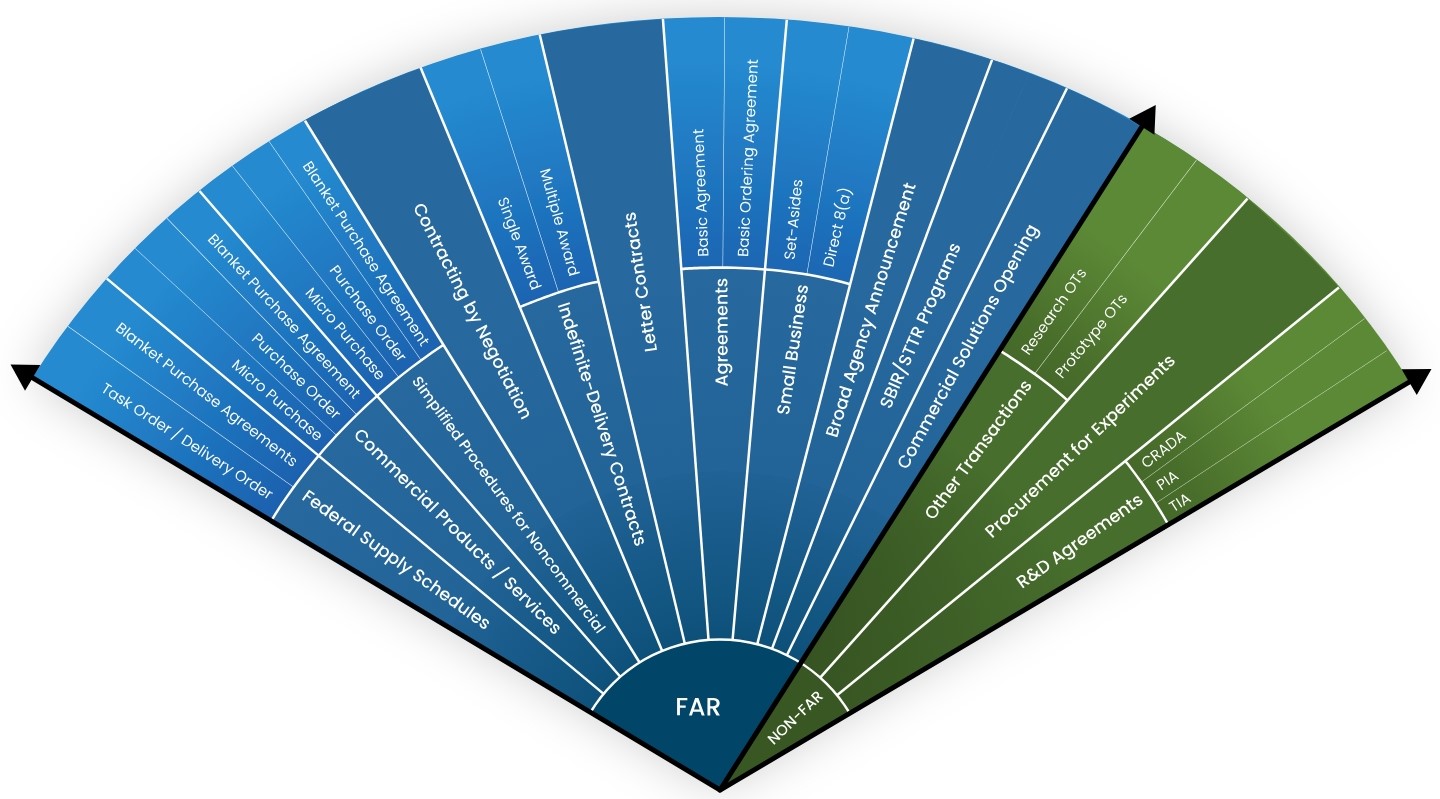
FAR Based Strategies
Ordering under the Federal Supply Schedule
Acquisition of Commercial Products and Commercial Services
Simplified Procedures for Noncommercial Acquisitions
Contracting by Negotiation
Indefinite-Delivery Contracts
Letter Contracts
Agreements
Small Business
Broad Agency Announcement
Commercial Solutions Opening
Statutory Strategies
SBIR/STTR Programs
Other Transactions
Procurement for Experiments
R&D Agreements
Cooperative R&D Agreement
Partnership Intermediary Agreement
Technology Investment Agreement
Contract Type Matrix
Indefinite-Delivery Contracts / IDIQ Contracts
FAR Subpart 16.5
Indefinite-delivery contracts provide a method to acquire supplies or services when the exact times or quantities of future deliveries are not known at the time of contract award. FAR Subpart 16.5 covers indefinite-delivery contracts, including definite-quantity, requirements, and indefinite-quantity contracts. Indefinite-delivery/indefinite-quantity contracts, commonly called IDIQ contracts, allow agencies to place future task orders or delivery orders under an existing contract vehicle. RFO FAR Subpart 16.5 also continues to establish a preference for making multiple awards of indefinite-quantity contracts when appropriate.
Existing indefinite-delivery contract vehicles should be considered before establishing a new agency-specific single-award or multiple-award IDIQ vehicle. These vehicles may include agency contracts, Governmentwide acquisition contracts, multi-agency contracts, and other interagency acquisition vehicles. Agencies should confirm that the contemplated order is within the vehicle’s scope, period of performance, ceiling, and ordering terms before placing an order.
Ordering procedures for indefinite-delivery contracts are addressed in the RFO FAR 16.507 series. RFO FAR 16.507-2 addresses orders valued at or below the micro-purchase threshold; FAR 16.507-3 addresses orders above the micro-purchase threshold but not above the simplified acquisition threshold; FAR 16.507-4 addresses orders above the simplified acquisition threshold but not above $7.5 million; FAR 16.507-5 addresses orders above $7.5 million; FAR 16.507-6 addresses exceptions to fair opportunity; and FAR 16.508 addresses protests of orders.
Establishing a new agency-unique IDIQ contract may be an appropriate business decision to support a portfolio of programs when recurring needs are anticipated. New IDIQ contracts may be either:
Government-wide Acquisition Contracts (GWACs)
Governmentwide acquisition contracts, or GWACs, are task-order or delivery-order contracts for information technology established by one agency for Governmentwide use. GWACs are associated with specific statutory authority and are operated either by an executive agent designated by the Office of Management and Budget or under a delegation of procurement authority issued by GSA.
The Economy Act generally does not apply to orders placed under GWACs when a more specific statutory authority applies. GWACs are commonly used for information technology products, services, systems, and solutions.
Multi-Agency Contracts (MACs)
A multi-agency contract is a task-order or delivery-order contract established by one agency for use by multiple Government agencies to obtain supplies or services. MACs may be used when they are within scope and otherwise appropriate for the requirement.
The Economy Act may apply to some MAC orders when more specific statutory authority does not apply. More specific authorities may include authorities for Federal Supply Schedule ordering or GWAC ordering.
GWACs, MACs, and Federal Supply Schedule ordering are forms of interagency acquisition. RFO FAR Part 17 continues to cover interagency acquisitions under Subpart 17.5, with additional coverage at Subpart 17.6 for acquisitions by nondefense agencies on behalf of DoD.
Common Applications
- Supplies and services, including construction when within the vehicle’s scope
- Defense business systems
- Mission solutions and technologies
- IT software, products, systems, and services
- Weapon systems, aircraft, ships, and space systems
- Research and development
- Advisory and assistance services
- Engineering services
- Special studies
- Recurring requirements suitable for task-order or delivery-order placement
Pros |
Cons |
| Access to existing contract vehicles may reduce procurement lead time. | Scope, ceiling, period of performance, ordering limitations, and vehicle terms may limit flexibility. |
| Pre-competed contract vehicles may provide access to qualified contractors and established terms. | Fair opportunity requirements generally apply to orders under multiple-award IDIQ contracts above the micro-purchase threshold unless an exception applies. |
| Task-order and delivery-order procedures can be tailored to the order and vehicle terms. | Orders above applicable thresholds may be protestable. |
| Multiple-award IDIQs can support competition at the order level. | The acquisition team must document scope, fair opportunity, exceptions, and pricing decisions. |
| Existing GWACs and MACs may provide efficient access to specialized capabilities. | Interagency acquisition rules and ordering-agency responsibilities must be addressed. |
Restrictions
- The order must be within the IDIQ vehicle’s scope, ordering period, ceiling, and terms.
- The contracting officer must confirm the contemplated requirement can properly be placed under the selected vehicle.
- For multiple-award IDIQ contracts, fair opportunity generally applies to orders above the micro-purchase threshold unless an exception applies.
- RFO FAR 16.507-6 addresses exceptions to fair opportunity.
- RFO FAR 16.508 addresses protests of orders.
- Interagency acquisitions must comply with applicable FAR Part 17 requirements.
- DoD users should also check applicable DFARS/PGI coverage and any current DoD class deviations before relying on the vehicle.
Resources
- FAR Overhaul Part 2 Definitions of Words and Terms
- FAR Overhaul Subpart 16.5 Indefinite-Delivery Contracts
- FAR Part 16 Types of Contracts Practitioner Album
- FAR Overhaul Part 17 Special Contracting Methods
- FAR Overhaul Part 19 Small Business Programs
- DFARS FAR Overhaul Class Deviations
- GAO Report 18-412R: Use by the DoD of Indefinite-Delivery Contracts from Fiscal Years 2015-2017, Government Accountability Office
- Interagency Contract Directory (GSA)
- NASA SEWP GWAC, National Aeronautics and Space Administration
- NITAAC GWACs, National Institutes of Health Information Technology Acquisition and Assessment Center
- OASIS+ Multi-Agency Contract Program
- DoD Information Analysis Center Multiple Award Contract (IAC MAC)