
Contracting Cone
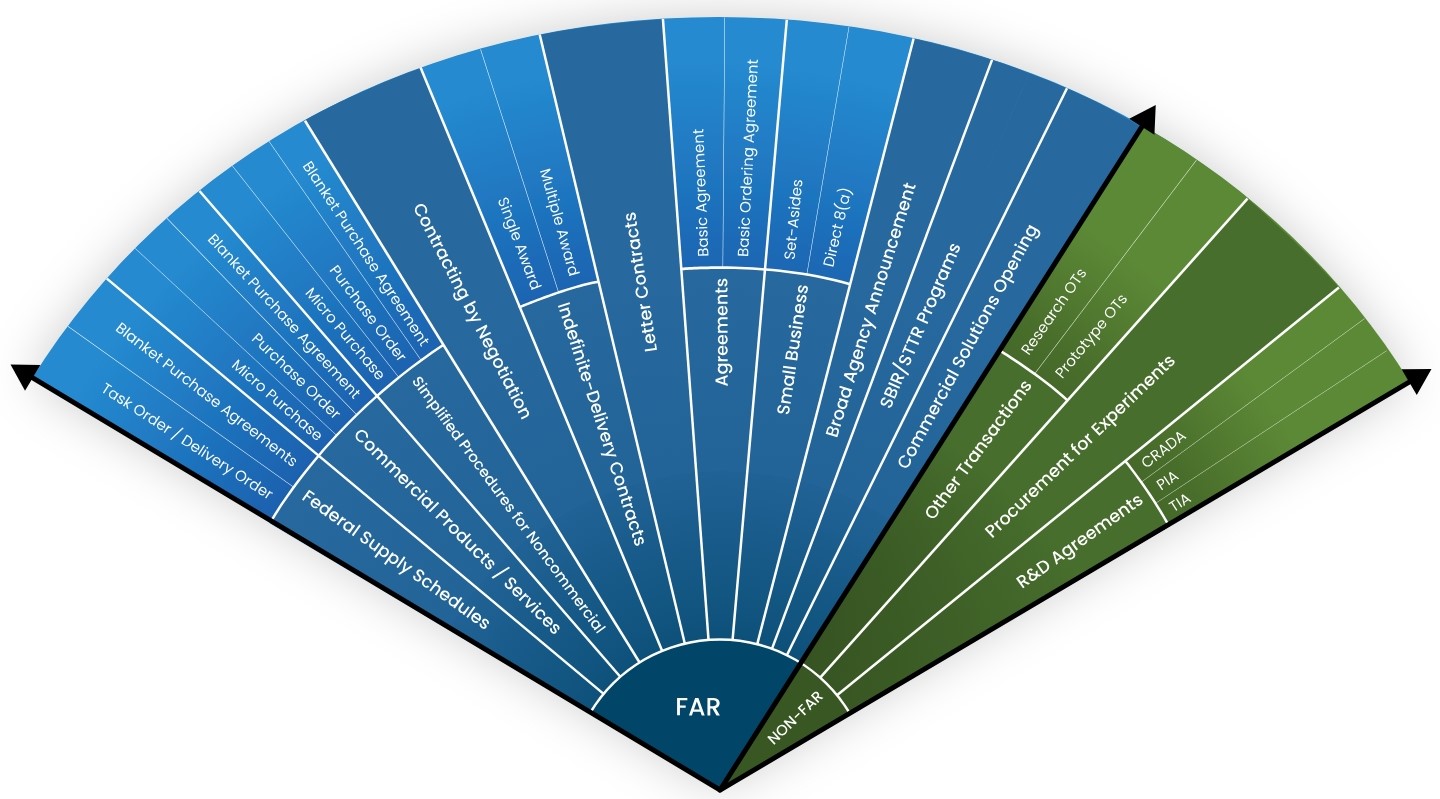
FAR Based Strategies
Ordering under the Federal Supply Schedule
Acquisition of Commercial Products and Commercial Services
Simplified Procedures for Noncommercial Acquisitions
Contracting by Negotiation
Indefinite-Delivery Contracts
Letter Contracts
Agreements
Small Business
Broad Agency Announcement
Commercial Solutions Opening
Statutory Strategies
SBIR/STTR Programs
Other Transactions
Procurement for Experiments
R&D Agreements
Cooperative R&D Agreement
Partnership Intermediary Agreement
Technology Investment Agreement
Contract Type Matrix
IDIQ — Multiple Award
FAR 16.504 / FAR 16.504-3 / FAR 16.507
A multiple-award indefinite-delivery/indefinite-quantity contract may be established when the Government knows the general type of supplies or services it needs and expects ongoing, repeated requirements, but does not know the exact quantity or timing of future orders. The base contracts establish the overall scope, ordering period, minimum and maximum quantities or dollar values, ordering procedures, and applicable terms and conditions. Individual requirements are funded and ordered through task orders or delivery orders issued under the multiple-award contract.
RFO FAR 16.504-3 establishes a preference for making multiple awards of indefinite-quantity contracts to the maximum extent practicable. The contracting officer must document the decision whether to make multiple awards in the acquisition plan or contract file. RFO FAR 16.504-4 also allows on-ramps and off-ramps to maintain a current, competitive, and innovative pool of vendors.
When placing orders under a multiple-award contract, the contracting officer must provide each awardee a fair opportunity to be considered for each order or BPA valued above the micro-purchase threshold, unless a sole-source order or BPA is justified and approved under FAR 16.507-6. RFO FAR 16.507 contains the ordering procedures for multiple-award contracts, including different procedures for orders above the micro-purchase threshold but not above the SAT, orders above the SAT but not above $7.5 million, and orders above $7.5 million.
For DoD, NASA, and the Coast Guard, the contracting officer may choose not to include price or cost as an evaluation factor at the base multiple-award contract level when the solicitation is above the SAT, will result in multiple-award contracts for the same or similar services, and states that the Government intends to award to each qualifying offeror. If price or cost is not evaluated at the base contract level, it must be considered for each order placed under the contract. This exception does not apply to solicitations that provide for sole-source orders under the 8(a) program.
Common Applications
- Supplies and services, including construction when appropriate
- Defense business systems
- Mission solutions and technologies
- IT software, products, systems, and services
- Weapon systems
- Aircraft, ships, and space systems
- Research and development
- Advisory and assistance services
- Engineering services
- Special studies
- Recurring requirements where competition at the order level is beneficial
Pros |
Cons |
| Maintains competition at the order level, reducing vendor lock and pricing risk. | Multiple vendors can increase contract administration and ordering complexity. |
| Allows the Government to establish contract terms and ordering procedures up front. | Fair opportunity procedures may add time at the order level. |
| Supports best-value selection among multiple awardees for individual orders. | Orders above applicable thresholds may be protestable under FAR 16.508. |
| Can support agency-wide ordering when the contract is properly scoped and structured. | The Government may need to manage integration across multiple vendors. |
| On-ramps and off-ramps can help maintain a current and competitive vendor pool. | Establishing the multiple-award IDIQ may require significant acquisition planning and lead time. |
Restrictions
- RFO FAR 16.504-3 establishes a preference for multiple awards of indefinite-quantity contracts to the maximum extent practicable.
- The contracting officer must document the decision whether to make multiple awards in the acquisition plan or contract file.
- Orders must remain within the scope, ceiling, ordering period, and terms of the base multiple-award contract.
- Fair opportunity is generally required for each order or BPA valued above the micro-purchase threshold.
- Fair opportunity procedures are addressed at FAR 16.507-2 through 16.507-5.
Exceptions to fair opportunity are addressed at FAR 16.507-6. - Order protests are addressed at FAR 16.508.
- Small business order set-asides and reserves are addressed through FAR Part 19 and Public Law 111-240, 15 U.S.C. § 644(r), and are not subject to the justification, approval, and posting requirements for fair opportunity exceptions.
- For DoD, NASA, and the Coast Guard, if price or cost is not evaluated at the base contract level under FAR 16.501-2(b)(2), price or cost must be considered for each order.